
The Workforce That Built the Eiffel Tower

Updated: Mar 21
The Workers Who Built the Eiffel Tower: Life on the Beams
When people admire the Eiffel Tower, they often think about its designer, Gustave Eiffel, or the revolutionary engineering that made the structure possible. But behind this towering achievement stood a group of highly skilled workers who risked their lives assembling the iron giant high above the streets of Paris.
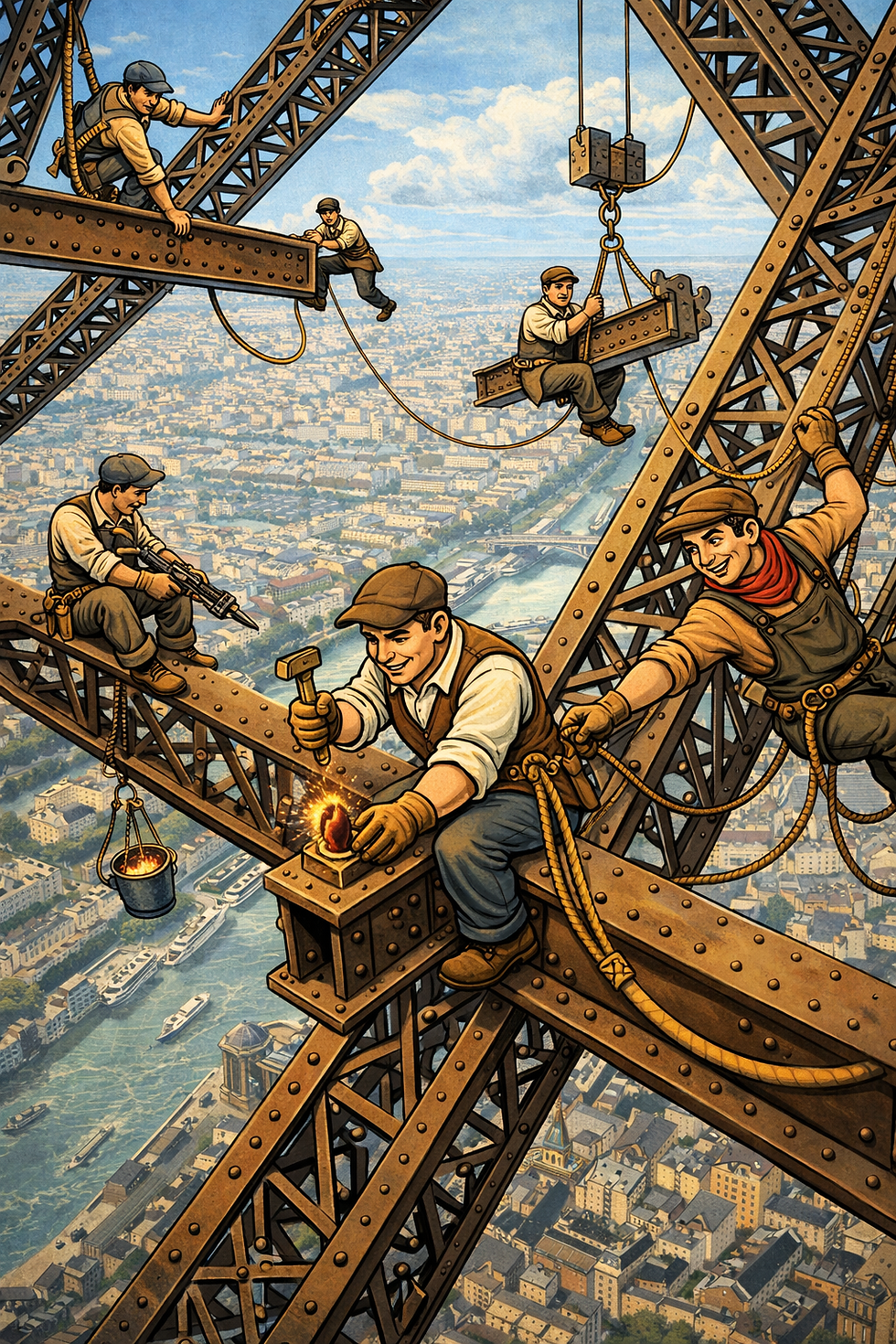
The construction of the Eiffel Tower between 1887 and 1889 required a dedicated workforce that operated under challenging and sometimes dangerous conditions. Workers climbed narrow beams, balanced hundreds of meters above the ground, and installed thousands of rivets while suspended in the air.
Despite the extreme working environment, the project was completed with a surprisingly low number of accidents, thanks in part to innovative safety measures introduced by Eiffel’s team.
The story of the Eiffel Tower is not just about engineering brilliance—it is also about the craftsmanship, courage, and coordination of the workers who assembled one of the world’s most famous structures.
A Workforce of Skilled Ironworkers
At the peak of construction, approximately 300 workers were employed on the Eiffel Tower site. While this number might seem small for such a massive project, it reflects the highly organized nature of the work.
The workforce was divided into specialized groups that included:
Ironworkers assembling structural members
Crane operators managing lifting equipment
Engineers and supervisors overseeing construction
Surveyors ensuring alignment and accuracy
Many of these workers were experienced metalworkers and bridge builders, familiar with working on large iron structures.
Their skill and coordination were essential to assembling the tower’s 18,000+ iron components safely and efficiently.
Life Working High Above Paris
Working on the Eiffel Tower meant operating at extreme heights, something that was relatively uncommon in construction at the time.
As the tower grew taller, workers found themselves performing tasks hundreds of meters above the ground. There were no modern elevators during construction, so workers had to climb the structure using temporary stairways and ladders.
Standing on narrow iron beams, workers installed structural members and rivets while maintaining balance and coordination.
Strong winds, cold temperatures, and rain could make working conditions even more challenging.
Despite these difficulties, many workers became highly skilled at navigating the tower’s lattice framework. Their ability to move confidently along the beams was crucial for maintaining productivity and safety.
The Riveting Teams
One of the most demanding tasks performed by the workforce was riveting, the process used to permanently fasten the tower’s iron components together.
Installing rivets required teams of four workers, each performing a specific role.
These teams worked quickly and efficiently, installing millions of rivets throughout the structure.
The four-person riveting team typically consisted of:
A worker heating the rivets in a small forge
A worker passing the hot rivet to the installers
A worker holding the rivet in position
A riveter hammering the metal to form the second head
The rivets were heated until red-hot, inserted into the iron plates, and hammered into place before cooling.
As the rivet cooled, it contracted slightly, pulling the connected members tightly together and creating an extremely strong joint.
This process required speed, teamwork, and precision, particularly when working at height.
Steam-Powered Cranes and Material Handling
Transporting iron components up the tower was another major challenge for the workforce.
The construction team used steam-powered cranes mounted on the structure itself to lift materials as the tower grew taller.
These cranes moved along rails installed on the tower’s legs and allowed workers to lift heavy iron sections into position.
Workers on the beams then guided the components into place before fastening them with temporary bolts and permanent rivets.
The coordination between crane operators and ironworkers was critical to keeping the construction process moving efficiently.
Innovative Safety Measures
Construction safety in the late 1800s was often minimal. Many large infrastructure projects of the time experienced high accident rates.
However, Gustave Eiffel placed a strong emphasis on worker safety, which was relatively progressive for that era.
Several safety innovations were introduced on the Eiffel Tower project.
Guard Rails and Safety Screens
Temporary guard rails and safety screens were installed in certain areas to reduce the risk of falls.
Moveable Work Platforms
Workers used movable platforms that allowed them to work more safely when installing structural components.
Organized Work Procedures
The construction process was carefully planned to reduce unnecessary risks. Prefabricated components allowed workers to spend less time performing complex fabrication tasks at height.
These measures significantly improved working conditions compared to other construction projects of the time.

A Surprisingly Low Fatality Rate
Given the height and complexity of the project, the construction of the Eiffel Tower recorded a remarkably low fatality rate.
Historical records suggest that only one worker died during the project, and this incident occurred outside normal working hours.
This was extremely unusual for large construction projects of the late 19th century, many of which experienced far higher accident rates.
The relatively safe completion of the tower demonstrated the effectiveness of Eiffel’s planning and safety policies.
It also reflected the professionalism and skill of the workforce involved.
The Role of Engineers and Supervisors
While the workers performed the physical labor of assembling the tower, engineers and supervisors played a crucial role in ensuring the structure was built accurately.
Surveyors continuously checked the alignment of the tower’s legs and structural components.
Engineers monitored:
Structural stability
Rivet installation quality
Crane operations
Assembly procedures
Because the tower’s design included curved legs that gradually converged, maintaining precise alignment during construction was critical.
Hydraulic jacks and adjustable supports allowed engineers to make small corrections as the structure rose higher.
The cooperation between engineers and workers ensured the tower was assembled safely and accurately.
A Construction Team That Made History
Although Gustave Eiffel is often credited as the mastermind behind the tower, the success of the project depended on the dedication and expertise of the workforce.
These workers spent months balancing on narrow beams, lifting heavy iron components, and installing millions of rivets under demanding conditions.
Their efforts transformed thousands of individual iron pieces into a structure that would become one of the most famous landmarks in the world.
Without their skill and determination, the Eiffel Tower would never have been completed.
Lessons for Modern Construction
The story of the Eiffel Tower’s workforce highlights several lessons that remain relevant for construction projects today.
Skilled Workers Are Essential
Even the most advanced engineering designs depend on skilled workers who can execute the construction process effectively.
Safety Planning Matters
Thoughtful safety measures can significantly reduce the risks associated with complex construction projects.
Coordination Improves Efficiency
Successful projects require strong coordination between engineers, supervisors, and workers.
Construction Is a Team Effort
Large structures are never built by a single individual—they are the result of collaboration among many professionals.
Remembering the Workers Behind the Tower
Today, millions of visitors travel to Paris each year to see the Eiffel Tower.
Most admire its height, its elegant design, and its breathtaking views of the city.
But hidden within its iron framework is the legacy of the workers who built it—the men who climbed its beams, hammered its rivets, and assembled the structure piece by piece.
Their work transformed an ambitious engineering concept into a lasting monument that continues to inspire engineers, architects, and builders around the world.
More than a century later, the Eiffel Tower still stands strong—thanks not only to brilliant engineering, but also to the dedication of the workforce that brought it to life.


Comments