
How the Eiffel Tower Resists Wind: Designed to stand tall

The Real Threat Was Never Gravity
When the Eiffel Tower was designed in the late 1800s, the biggest challenge wasn’t supporting its weight.
👉 It was resisting the wind.
At over 300 meters tall, the structure would be fully exposed to powerful and unpredictable forces. Unlike buildings surrounded by other structures, the tower stands largely isolated — meaning wind hits it directly from all sides.
So the real question engineers had to answer was:
👉 How do you stop a tall, slender structure from being pushed over?
The answer lies in one of the most intelligent structural designs ever created.

Understanding Wind Loads on Tall Structures
Wind is not just air moving past a structure — it creates pressure and suction forces.
When wind hits a structure:
The front face experiences positive pressure
The sides and rear experience negative pressure (suction)
Turbulence creates vibrations and oscillations
For tall structures, this results in:
👉 Lateral forces (sideways loads)
These forces can:
Cause bending
Create instability
Lead to structural failure if not properly managed
The Core Principle: Don’t Fight the Wind — Work With It
Instead of trying to make the Eiffel Tower rigid and resistant, the engineers took a smarter approach:
👉 They designed it to let the wind pass through it.
This is one of the most important ideas in structural engineering.
The Lattice Design: Reducing Wind Resistance
The Eiffel Tower is not a solid structure — it is a lattice framework.
What this means:
Large open spaces between members
Minimal solid surface area
Wind can pass through the structure
Why this matters:
👉 Less surface area = less wind force
Compared to a solid wall:
A solid structure blocks wind → high pressure
A lattice structure allows airflow → reduced pressure
This dramatically lowers the load on the tower.
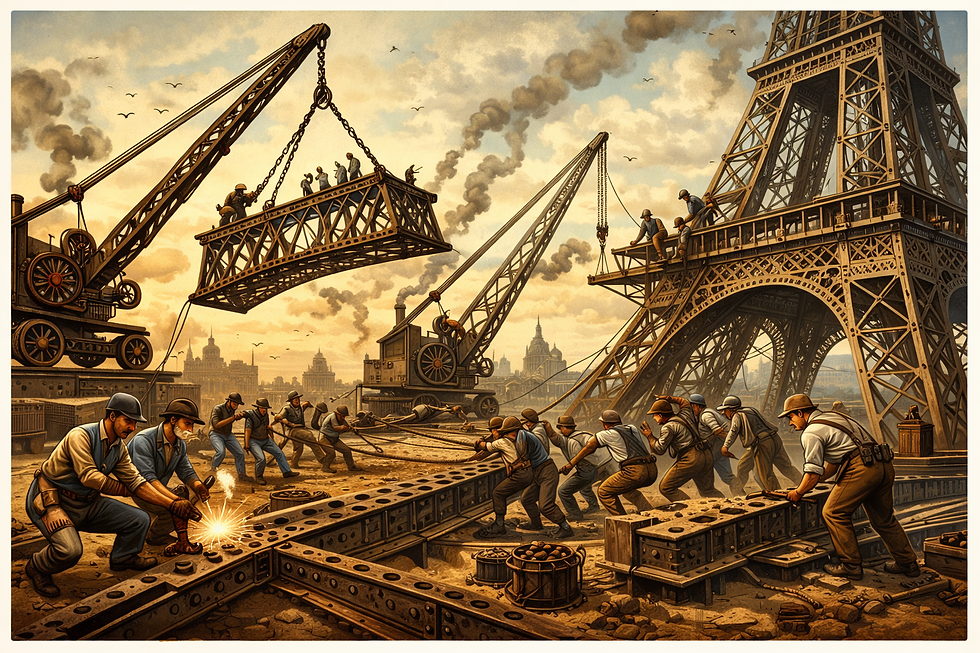
The Curved Shape: Following the Line of Force
One of the most distinctive features of the Eiffel Tower is its curved profile.
This wasn’t just aesthetic — it was intentional engineering.
The shape follows:
👉 The natural path of wind forces
As wind pressure increases higher up the tower:
The structure narrows
The curvature changes
Forces are directed down into the foundations
This creates an efficient load path, reducing stress on the structure.
Wind Load Calculations: Ahead of Its Time
Gustave Eiffel and his engineers performed detailed calculations to understand how wind would affect the tower.
Even without modern computers, they:
Estimated wind pressure at different heights
Calculated bending forces
Designed the structure to safely transfer loads
Their calculations ensured that:
👉 The tower could withstand extreme wind conditions without failing.
Flexibility: Allowing Movement Instead of Preventing It
Another key design decision was:
👉 Allowing the tower to move slightly.
Instead of making it completely rigid, engineers designed it to:
Flex under wind load
Absorb energy
Return to its original position
In practice:
The Eiffel Tower can sway several centimeters in strong winds
This movement reduces stress in the structure
This principle is still used in modern skyscrapers today.

Weight Distribution: Stability from the Ground Up
The tower’s wide base plays a major role in resisting wind.
Key features:
Four large legs spread outwards
A broad footprint
This creates:
👉 A very stable base
The wider the base, the harder it is for wind forces to cause overturning.
Truss System: Strength Without Excess Weight
The Eiffel Tower uses a system of:
👉 Triangular trusses
Triangles are one of the strongest shapes in structural engineering.
Why triangles work:
They distribute forces evenly
They prevent deformation
They create rigidity without adding mass
This allowed the tower to be:
✔️ Lightweight
✔️ Strong
✔️ Efficient under wind loads
How the Tower Handles Extreme Wind Conditions
Even during strong storms, the Eiffel Tower remains stable because:
Wind passes through the structure
Loads are distributed efficiently
The tower can flex slightly
The base provides stability
All these systems work together.
👉 Not one solution — but a combination of many.
Comparison: Eiffel Tower vs Modern Skyscrapers
Modern buildings use different methods to handle wind, such as:
Tuned mass dampers
Reinforced concrete cores
Aerodynamic shaping
But the core principles remain the same:
✔️ Reduce wind pressure
✔️ Control movement
✔️ Distribute loads effectively
Key Engineering Principles Behind the Design
1. Reduce Surface Area
Less material exposed to wind = less force.
2. Use Open Structures
Allow airflow instead of blocking it.
3. Shape Matters
Curved forms distribute forces more efficiently.
4. Allow Controlled Movement
Flexibility reduces stress.
5. Distribute Loads Properly
Forces must be transferred safely to the ground.
Conclusion: A Structure That Works With Nature
The Eiffel Tower is not just strong — it is intelligently designed.
Instead of resisting nature, it works with it.
By combining:
Open lattice design
Curved geometry
Stable foundation system
👉 Engineers created a structure that could stand tall against the forces of wind for over a century.
It remains one of the best examples of efficient structural design in history.


Comments