
How the Eiffel Tower Was Assembled

Updated: Mar 27
How Workers Built the Eiffel Tower Without Modern Cranes
When construction of the Eiffel Tower began in January 1887, the world had never seen anything like it. Rising more than 300 meters above Paris, the tower was designed to be the tallest man-made structure on Earth at the time.
Today, massive projects like this rely on tower cranes, heavy lifting machinery, computerized design systems, and precision fabrication plants. But when Gustave Eiffel’s team began constructing the tower in the late 19th century, none of those technologies existed.
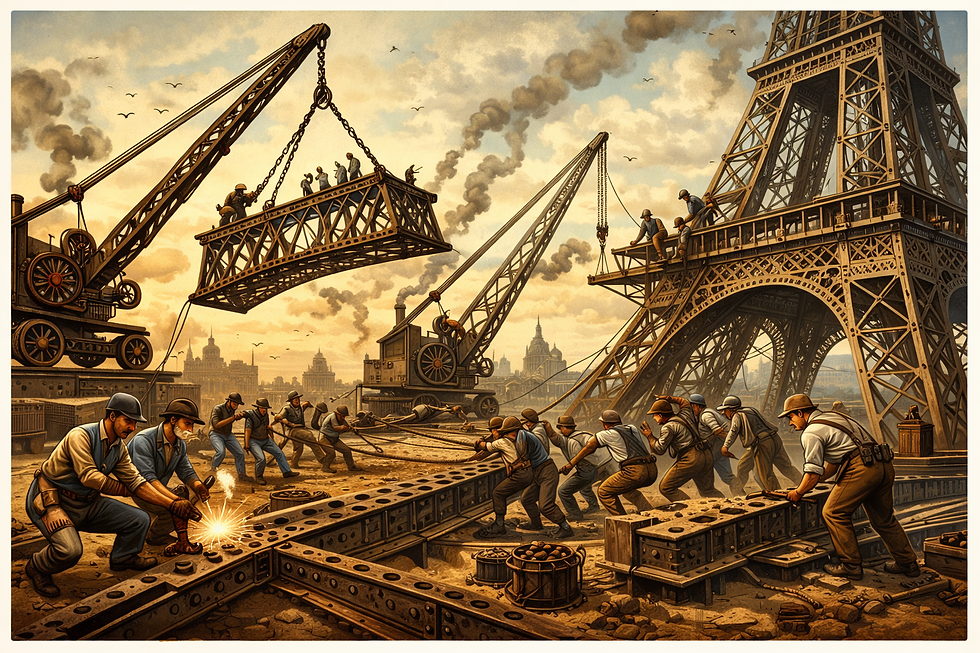
Instead, workers assembled the entire structure using prefabricated iron components, manual alignment techniques, steam-powered cranes, and thousands of riveted connections.
Despite these limitations, the tower was completed in just 2 years, 2 months, and 5 days — a remarkable achievement that still impresses engineers today.
Understanding how the Eiffel Tower was assembled reveals important lessons about precision engineering, prefabrication, and structural assembly, many of which still influence modern construction.
The Prefabrication Strategy That Made the Project Possible
One of the key innovations that allowed the Eiffel Tower to be constructed efficiently was extensive prefabrication.
Instead of fabricating parts on site, Gustave Eiffel’s company manufactured the majority of the tower’s components in a factory workshop in Levallois-Perret, near Paris.
This strategy allowed engineers to ensure:
Accurate dimensions
High quality control
Faster assembly on site
Reduced errors during erection
Each structural element was carefully produced according to detailed engineering drawings.
The entire structure consisted of:
18,038 individual wrought iron pieces
Over 2.5 million rivets
Approximately 7,300 tons of iron
Every piece was designed to fit precisely with the others, creating the tower’s intricate lattice framework.
In many ways, this approach resembles the modern prefabrication techniques used in steel construction today.

Precision Engineering Before Computers
What makes the Eiffel Tower even more impressive is the fact that all engineering calculations were performed without computers.
Designers relied on:
Hand calculations
Detailed drafting
Mathematical tables
Physical scale models
Despite these limitations, the iron components were fabricated with incredible precision.
In fact, the tolerance for many parts was less than one-tenth of a millimeter — an astonishing level of accuracy for the late 1800s.
Each component was numbered and labelled before being transported to the construction site, ensuring workers knew exactly where it belonged in the structure.
This level of organization allowed the tower to be assembled almost like a giant mechanical puzzle.
Building the Tower’s Four Massive Foundations
Construction began with the tower’s four massive foundations, which support the enormous weight of the structure.
Each leg of the tower sits on its own concrete foundation block.
Because two of the legs are positioned closer to the Seine River, engineers had to use compressed air caissons to stabilize the ground during construction.
Once the foundations were completed, workers installed large anchor bolts that would connect the tower’s iron legs to the base.
These anchor bolts played a critical role in ensuring the stability of the structure.
The Challenge of Aligning the Four Tower Legs
The Eiffel Tower’s design includes four massive curved legs that rise from the ground and gradually converge toward the center.
Aligning these legs accurately was one of the most difficult challenges of the entire construction process.
Engineers used hydraulic jacks and sandboxes to control the positioning of the legs during assembly.
This allowed them to make extremely small adjustments to ensure the structure remained perfectly aligned.
Once the legs reached the height of the first platform, the structure finally became rigid and self-supporting.
From that point onward, construction became much easier.
Temporary Wooden Scaffolding
Before the structure became stable, workers relied heavily on temporary wooden scaffolding to support the iron components.
These scaffolds allowed workers to reach high elevations and position structural members during assembly.
However, the scaffolding could only support limited weight.
Because of this, engineers had to carefully plan the assembly sequence to ensure the structure remained stable at all times.
As the tower grew taller, much of the scaffolding was gradually removed.
This careful coordination allowed the construction team to maintain safety while continuing to build upward.
Steam-Powered Cranes on the Structure
One of the most innovative aspects of the Eiffel Tower’s construction was the use of steam-powered cranes that climbed the tower itself.
Instead of relying solely on ground-based lifting equipment, engineers installed cranes directly onto the structure.
These cranes ran on temporary tracks built along the tower’s legs, allowing them to move upward as construction progressed.
The cranes were powered by steam engines and were capable of lifting heavy iron components into position.
This ingenious system allowed workers to continue assembling the tower even at extreme heights.
In many ways, these cranes were the precursors to modern tower cranes used on skyscraper construction today.
Assembling Over 18,000 Iron Pieces
The tower’s framework consists of more than 18,000 individual iron components.
Each piece had to be carefully lifted into place and aligned with adjacent members before being permanently fastened.
During assembly, workers initially used temporary bolts to hold components together.
Once the alignment was confirmed, these temporary fasteners were replaced with permanent riveted connections.
This method ensured that each section of the tower was assembled accurately before the final connections were installed.

Installing the 2.5 Million Rivets
Riveting was the primary method used to permanently connect the tower’s iron components.
In total, approximately 2.5 million rivets were installed during construction.
Each rivet required a four-person team to install:
A worker heated the rivet in a portable forge
Another passed the red-hot rivet to the installation team
A worker held the rivet in place
The riveter hammered the metal to form the second head
Once installed, the rivet cooled and contracted slightly, pulling the connected pieces tightly together.
This created extremely strong and durable connections that still hold the tower together today.
Remarkably Few Accidents
Considering the height and complexity of the project, the construction of the Eiffel Tower had surprisingly few accidents.
This was partly due to Gustave Eiffel’s strong emphasis on safety.
Protective measures included:
Guard rails
Moveable platforms
Safety screens
These precautions were unusual for construction projects of the era.
As a result, the tower was completed with only one recorded fatal accident, which was remarkably low for a project of that scale at the time.
Construction Speed That Still Impresses Engineers
The Eiffel Tower was constructed in just over 26 months, an extraordinary achievement considering the technology available in the 1880s.
Several factors contributed to this speed:
Precise engineering drawings
Organized assembly procedures
Innovative lifting equipment
Skilled workers
Because most parts were manufactured off-site, the construction team was able to focus primarily on assembly rather than fabrication.
This approach mirrors modern construction methods used in steel structures, bridges, and industrial buildings today.
Lessons for Modern Steel Construction
The assembly of the Eiffel Tower offers valuable lessons that remain relevant for engineers and construction professionals today.
Prefabrication Improves Efficiency
Manufacturing structural components off-site allows for better quality control and faster installation.
Precise Engineering Is Critical
Accurate design and fabrication ensure that complex structures fit together correctly during assembly.
Innovative Lifting Methods Matter
Creative solutions for lifting and positioning materials can significantly improve construction efficiency.
Planning the Assembly Sequence Is Essential
Large structures must be assembled in a carefully planned order to maintain stability.
Why the Eiffel Tower Remains an Engineering Masterpiece
More than 130 years after its completion, the Eiffel Tower still stands as one of the most impressive construction achievements in history.
The fact that workers assembled such a massive structure without modern cranes, computers, or power tools makes the project even more remarkable.
Through careful planning, precise fabrication, and skilled craftsmanship, Gustave Eiffel’s team created a structure that continues to inspire engineers around the world.
Today, the tower remains a powerful reminder that great engineering is not just about technology — it is about vision, precision, and execution.
And the Eiffel Tower remains one of the greatest examples of that truth ever built.


Comments