
How the Eiffel Tower’s Foundations Were Built

Updated: Mar 27
Engineering the Base of an Icon
The Part of the Eiffel Tower You Never See
When people think about the Eiffel Tower, they usually picture its height, its lattice iron structure, or its place in the Paris skyline.
But the real story begins underground.
Long before the first iron components were assembled, engineers faced a far more difficult challenge:
👉 How do you support a 300+ meter structure on uneven ground, right next to a river?
The answer lies in one of the most impressive foundation systems of the 19th century — a combination of deep excavation, compressed air technology, and precise engineering.
Understanding how the Eiffel Tower’s foundations were built reveals something important:
👉 Great structures don’t start with what you see — they start with what you don’t.

The Site: A Difficult Location Next to the Seine River
The Eiffel Tower stands on the Champ de Mars in Paris, adjacent to the Seine River. While the location offered visibility and prominence, it introduced serious engineering complications.
The key issue: inconsistent ground conditions
The four legs of the tower were not built on identical so
il:
Two legs near the river
Soft, water-saturated soil
High groundwater levels
Low natural bearing capacity
Two legs further inland
More stable and compact soil
Better load-bearing characteristics
This meant that engineers could not rely on a uniform foundation design.
👉 Each foundation had to be tailored to its specific ground conditions.
Why the Foundations Were So Critical
The Eiffel Tower is not a conventional vertical structure.
Its design creates unique structural demands:
Four angled legs rather than a central column
Significant wind exposure due to height and shape
Complex load distribution, especially during construction
This meant the foundations had to do more than simply carry weight.
They needed to:
Transfer loads safely into the ground
Resist overturning forces caused by wind
Maintain alignment between all four legs
Allow adjustments during assembly
Even small inaccuracies at foundation level could have resulted in major structural issues higher up.
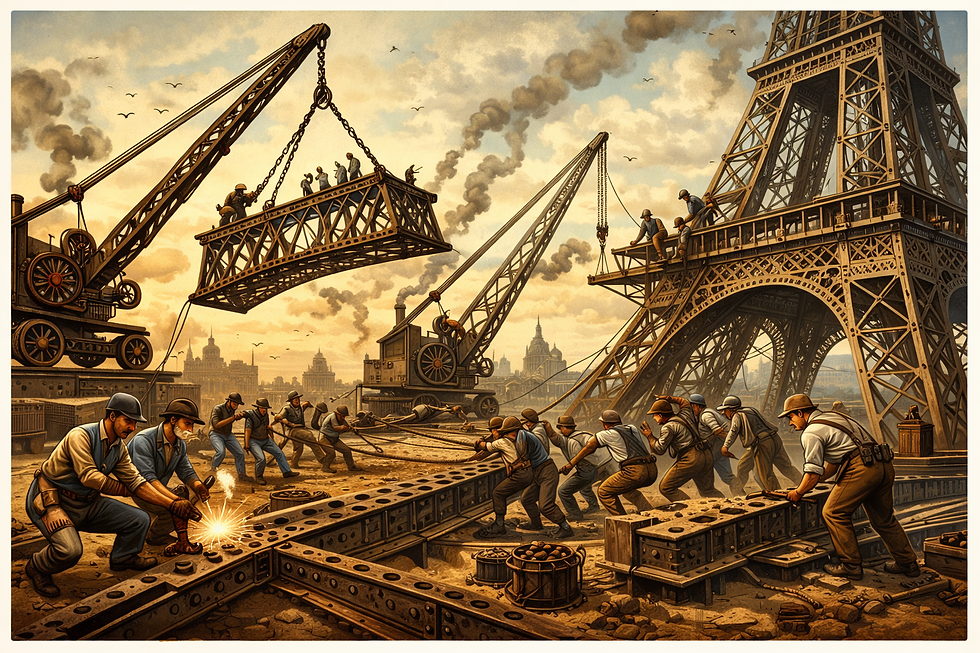
The Foundation Concept: Four Independent Support Systems
Rather than using a single continuous base, the Eiffel Tower was built on:
👉 Four separate foundations — one for each leg
Each foundation functioned independently, yet all four had to work together to support the structure.
Each base consisted of:
A deep concrete footing
A large masonry block
Anchor systems connecting the iron structure
This design allowed engineers to control and adjust each leg individually during construction.
The Major Challenge: Groundwater and Excavation
The two inland foundations could be constructed using relatively straightforward excavation methods.
However, the two foundations closest to the Seine presented a major obstacle:
👉 Groundwater intrusion.
Excavation below the water table would normally result in flooding and unstable working conditions.
To solve this, engineers used an advanced technique known as:
Compressed Air Caissons
This method was one of the most innovative construction techniques of the time.
How caissons worked:
A sealed chamber was placed into the ground
Compressed air was pumped inside the chamber
The air pressure prevented water and soil from entering
Workers entered the chamber to excavate soil manually
This allowed excavation to continue safely below the water table.
Once the required depth was reached:
The chamber was filled with concrete
A solid, stable foundation base was created
Although effective, this method was physically demanding and carried risks due to the pressurised environment.

Step-by-Step Construction of the Foundations
1. Excavation of the Foundation Pits
Each of the four legs required a deep excavation:
Inland foundations → open excavation
River-side foundations → excavation using caissons
The objective was to reach soil layers capable of supporting the tower’s weight.
2. Installation and Sinking of Caissons
For the two river-side foundations:
Caissons were gradually sunk into the ground
Soil was removed from inside the chamber
Compressed air maintained a dry working environment
This process continued until stable ground was reached.
3. Pouring the Concrete Base
Once excavation was complete:
Thick concrete layers were poured into the foundation pits
This created a strong, level base
Loads were distributed over a larger area
This principle — spreading loads to reduce pressure — remains fundamental in modern foundation design.
4. Construction of Masonry Blocks
On top of the concrete base:
Large masonry blocks were built
These formed the visible foundation above ground
They helped distribute loads and support the iron structure
5. Installation of Anchor Systems
Before assembly of the tower began:
Anchor bolts were embedded into the foundations
These bolts connected the iron legs to the base
Accuracy at this stage was essential.
👉 Misalignment at foundation level would affect the entire structure.
Precision Engineering: Aligning the Four Legs
One of the most remarkable aspects of the Eiffel Tower’s construction was the precision achieved during assembly.
Engineers used:
Adjustable supports
Surveying instruments
These tools allowed them to:
Fine-tune the position of each leg
Ensure that all four legs met accurately at higher levels
Considering the scale of the structure, this level of precision was extraordinary.
Why These Foundations Were So Advanced
For the late 19th century, the foundation system of the Eiffel Tower represented a major engineering achievement.
It combined:
Site-specific design solutions
Deep foundation techniques
Use of compressed air technology
High levels of construction accuracy
These innovations made it possible to construct a structure of unprecedented height and complexity.
Key Engineering Principles Demonstrated
The foundations of the Eiffel Tower highlight several important engineering principles:
1. Adapt to Ground Conditions
Different soil conditions require different construction methods.
2. Transfer Loads Effectively
Foundations must distribute loads safely into the ground.
3. Control Water During Construction
Groundwater can significantly affect excavation and stability.
4. Prioritise Precision
Small errors at foundation level can lead to major structural issues.
5. Design for Construction, Not Just Final Use
The structure must remain stable throughout every stage of the build.
How the Foundations Supported the Entire Structure
Once completed, the foundations provided:
A stable base for the iron structure
They also allowed the tower to accommodate:
Dynamic loading
Environmental exposure over time
More than 130 years later, these foundations continue to perform their role effectively.
Conclusion: The Strength Beneath the Surface
The Eiffel Tower is often celebrated for its design and height, but its success begins below ground.
From the use of compressed air caissons to the careful distribution of loads, the foundations represent a critical part of the project’s engineering.
They demonstrate a simple but powerful idea:
👉 A structure’s strength is determined long before it rises above the ground.
Understanding how the Eiffel Tower’s foundations were built provides valuable insight into both historical and modern construction practices — and highlights the importance of getting the fundamentals right from the very beginning.


Comments